
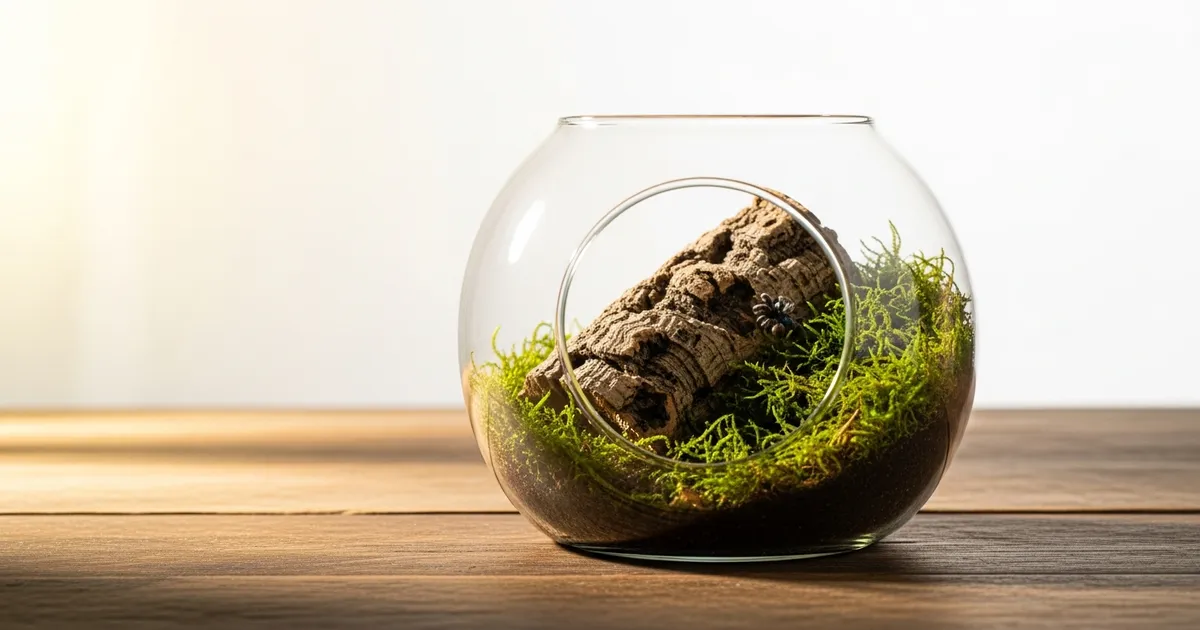
The wrong enclosure does not just look bad on a shelf. It stresses your spider, causes molting problems, breeds mold, and in the worst case lets a spiderling through a mesh gap that is one millimeter too wide. Most buyer guides skim past this because they are reviewing everything on Amazon with a 4-star rating. This one covers what experienced keepers actually use, with honest flaws included.
Affiliate disclosure: Some links on this page are affiliate links. Bugnook earns a small commission if you buy through them, at no extra cost to you. We only list enclosures keepers have actually used long-term.
Key Takeaways
- Jumping spiders are arboreal: height matters more than floor space, always
- Cross-ventilation (air entering from one point, exiting another) prevents mold and keeps humidity stable
- Front-opening doors are not a luxury: top-access lids tear the silk retreat your spider sleeps in
- Adult Phidippus regius females need at least 30 cm of height; the Exo Terra Nano Tall is the cleanest option
- Do not put a spiderling under 1 cm in a glass enclosure: a modified deli cup beats it for every practical reason
- All-screen enclosures are a consistent failure: claws snag on large-gauge mesh, humidity plummets, mold still finds the bottom corners
- Size up at every other molt, not every molt
Quick Comparison: Best Jumping Spider Enclosures
| Enclosure | Best for | Size | Material | Cross-vent | Front door | Price |
|---|---|---|---|---|---|---|
| Exo Terra Nano Tall | Adult females (P. regius) | 20x20x30 cm | Glass | Yes | Yes | $50-$75 |
| Exo Terra Nano Wide | Adult males, display | 20x20x20 cm | Glass | Yes | Yes | $45-$65 |
| BFP Flat-Top 5x5x8 | Subadults, adult males | 12.7x12.7x20 cm | Acrylic | Yes | Yes | $22-$30 |
| BFP Den 4x4x4 | Juveniles 1-2 cm | 10x10x10 cm | Acrylic | Yes | Yes | $15-$20 |
| Tarantula Cribs Coffin Crib | Display, subadults/adults | Medium varies | Acrylic | Yes | Yes | $25-$45 |
| 32 oz deli cups | Spiderlings under 1 cm | 32 oz | Plastic | DIY | No | Under $2 |
For detailed enclosure setup including substrate, decor, and humidity targets, see the jumping spider enclosure setup guide.
What Makes a Good Jumping Spider Enclosure
Cross-ventilation, not just a mesh top
Cross-ventilation means air enters from one point and exits from another, creating actual airflow through the space. A single mesh top with no lower vents creates a dead-air column: warm and stagnant at the bottom, moisture accumulating in the substrate, the spider sitting at the top in its retreat. Eventually that stagnant lower half grows mold regardless of how carefully you mist.
A good enclosure has ventilation at two different heights: ideally a lower front vent strip and a mesh top, or mesh panels on two opposite sides. The stack effect, warm air rising through the top and drawing fresh air in at the bottom, keeps the interior stable without constant intervention.
Height over footprint
Jumping spiders are arboreal. In the wild, a regal jumping spider spends most of its time 1-3 meters off the ground on tree bark and foliage. In captivity they build their silk retreat at the highest point available and hunt the space below it. An enclosure that is 15 cm tall gives them almost nothing. An enclosure that is 30 cm tall gives them a proper range.
Floor space matters enough to fit a water dish and some cork bark, but the spider will not spend its time there.
Front-opening doors
Every time you lift a top-access lid you risk tearing the silk retreat the spider sleeps in. That retreat is not decoration: it is where the spider molts, where females lay eggs, and where the spider recovers after a stress response. A damaged retreat means a stressed spider, and a stressed spider approaching a molt is a real risk. Front doors open below the retreat. This one feature alone justifies the price difference between purpose-built spider enclosures and generic plastic tubs.
Material: glass vs. acrylic
Glass holds humidity more consistently and resists scratches that accumulate from cleaning and substrate movement. Acrylic is lighter, cheaper, and less likely to crack if dropped. For a permanent adult enclosure, glass is worth it. For a juvenile you will re-house every two to three molts, acrylic is the better call.
Sizing Guide by Spider Stage
What size enclosure does a jumping spider need? An adult Phidippus regius female needs a minimum of 20x20x30 cm (8x8x12 inches). Males, which run smaller, can live well in 15x15x25 cm. Spiderlings and juveniles need enclosures sized to roughly 3x their body length per dimension, small enough that prey is easy to locate.
| Spider stage | Body length | Minimum enclosure | Recommended height |
|---|---|---|---|
| Spiderling | Under 1 cm | 5x5x8 cm (deli cup) | 8 cm |
| Small juvenile | 1-1.5 cm | 8x8x10 cm | 12 cm |
| Juvenile | 1.5-2 cm | 10x10x15 cm | 18 cm |
| Subadult | 2-2.5 cm | 15x15x20 cm | 25 cm |
| Adult female (P. regius) | 18-22 mm | 20x20x30 cm | 30 cm |
| Adult male (P. regius) | 12-15 mm | 15x15x25 cm | 25 cm |
Size up at every second molt. A sure sign it is time: the spider starts pacing the glass walls rather than using the interior space.
Prey sizing by life stage is covered in the what do jumping spiders eat guide.
The 5 Best Jumping Spider Enclosures
1. Exo Terra Nano Tall: Best for Adult P. regius Females
Verdict: The top pick. Thirty centimeters of height, genuine cross-ventilation, glass construction, and front doors that actually function. Nothing else off the shelf matches this for a full-grown regal jumping spider.
Specs: 20x20x30 cm (8x8x12 in). Dual front-opening doors with magnetic closure. Lower front ventilation strip plus full mesh top. Raised bottom frame with cable ports. Glass panels.
What works: The 30 cm height is the primary reason this beats the Nano Wide. Adult P. regius females routinely hit 22 mm body length and they use every centimeter of vertical space they are given. The dual front doors open independently, so you can crack one side to drop prey in without opening the enclosure fully. Ventilation genuinely creates cross-flow: lower intake through the front strip, exhaust through the mesh top. Glass walls give clean sightlines and do not scratch from tweezers or substrate.
What does not work: The plastic locking tabs wear out with daily opens. After 6-12 months a binder clip on each door becomes necessary. The cable ports in the back frame have gaps large enough for a juvenile to squeeze through; seal them with foam weather-strip tape before housing anything under 1.5 cm.
Price: $50-$75 depending on retailer
Best for: Adult P. regius females, planted or bioactive display setups, keepers who want a permanent adult enclosure that functions well without modification.
Note on the Nano Wide: The Nano Wide (20x20x20 cm) is identical except for the 10 cm reduction in height. It works for adult males and for keepers where the Tall is out of stock, but if you are housing a large female, the Tall is worth tracking down.
2. BFP Flat-Top 5x5x8: Best for Subadults and Adult Males
Verdict: A jumping-spider-specific acrylic enclosure that solves the ventilation and fruit-fly containment problems that generic enclosures leave open.
Specs: 12.7x12.7x20 cm (5x5x8 in). Magnetic front door. 0.5 mm drilled ventilation holes front and back for true cross-ventilation. Cast acrylic.
What works: BigFATPhids designed this specifically for keeping jumping spiders, and the 0.5 mm holes are the most practical detail. Drosophila hydei at 3-4 mm cannot pass through them, which matters every feeding day when you open the door and drop in flies. The cast acrylic is noticeably clearer than cheaper injection-molded plastic. Magnets are strong and well-aligned; accidental openings are not a concern. Flat top stacks cleanly for multiple-spider setups.
What does not work: Acrylic scratches with abrasive cleaners. Use only a damp cloth. At 5x5 inches of floor space it is on the small side for a large adult P. regius female; size up to the 5x5x10 if your spider is on the larger end. Per-unit price is higher than generic containers and specialty shipping adds cost.
Price: $22-$30
Best for: Subadults, adult males, and smaller adult females. Keepers running multiple spiders who want a consistent, stackable setup.
3. BFP Den 4x4x4: Best for Juveniles (1-2 cm)
Verdict: A cube enclosure built for the juvenile stage, with the dual-vent design that matters most in a small space.
Specs: 10x10x10 cm (4x4x4 in). Front-opening magnetic door. Dual ventilation panels, one on the door and one on the back wall. Cast acrylic. 0.5 mm holes contain D. hydei.
What works: The dual-vent design solves the most common juvenile enclosure problem: stagnant air in a small space. Cross-ventilation at this scale is harder to achieve than in a large enclosure, and the BFP Den gets it right. A juvenile spider eating nothing but D. hydei twice a week needs an enclosure where flies cannot escape on entry; these holes hold them. Magnets are strong. Easy to clean and clear enough that you can observe feeding and molt behavior closely.
What does not work: Too small for anything approaching subadult size. Expect to re-house at the next molt or the one after. Decor has to be minimal: a small piece of cork bark and one climbing point is about all the space allows.
Price: $15-$20
Best for: Juveniles from 1 cm through approximately 1.5-2 cm. A clean step up from a deli cup without committing to a full adult enclosure.
4. Tarantula Cribs Coffin Crib: Best Display Enclosure
Verdict: The best-looking jumping spider enclosure available, and it functions well enough to be a serious option, not just a display piece.
Specs: Laser-cut acrylic in a coffin silhouette. Magnetic closure. Cross-ventilation drilled side panels at 0.5 mm or smaller. Front-access opening. Multiple size options; the medium fits subadult and adult P. regius comfortably.
What works: The tapered top is not just aesthetic. Jumping spiders consistently build their retreats in the narrower upper section, which suits both their natural preference for tight, elevated anchor points and the coffin geometry. The result is a setup where the spider uses the enclosure the way it is designed to be used. Magnets are consistently strong and well-aligned across units. Many keepers report their spiders web immediately in the top taper within the first day.
What does not work: The coffin shape means the useful floor space varies along the length, which makes decorating a puzzle. Stock availability is inconsistent; Tarantula Cribs restocks in batches and sells out. Check the size chart carefully before ordering.
Price: $25-$45 depending on size and colorway
Best for: Keepers who want a display enclosure that gets attention. Subadults and adults of most Phidippus species. Works well as a gift.
5. DIY Deli Cup: Best for Spiderlings (Under 1 cm)
Verdict: Not glamorous. The correct choice for any spider under 1 cm body length.
Specs: 32 oz clear deli container with snap lid, modified with ventilation holes: 4-6 holes on the side just below the lip, plus holes in the lid. Use a heated pin or 1 mm drill bit for clean holes without cracking the plastic.
What works: Spiderlings are tiny and need a small space. A large enclosure makes prey harder to locate, which leads to a hungry spider. A deli cup keeps fruit flies concentrated where the spider can find them. Cross-ventilation is achievable with side holes low and lid holes high. Cost is under $2 per setup, replaceable at every molt.
What does not work: Requires DIY modification. A heated metal skewer makes cleaner holes than a drill. Snap lids are less secure than magnetic closures; double-check the seal after every feeding. Plastic degrades in clarity over a few months.
Price: Under $2 from restaurant supply packs, often free from deli counters
Best for: Any spiderling under 1 cm. Raise here until 1-1.5 cm, then move to a juvenile enclosure. Do not skip this by putting a sling in an adult enclosure: it will struggle to locate prey.
What to Avoid
This section is what most buyer guides omit. Knowing what not to buy saves more money than knowing what to buy.
All-screen enclosures (reptile screen tanks) Tarsal claws, the adhesive structures on each foot, snag in large-gauge screen mesh. A panicked spider that catches a claw while fleeing can lose a leg. Screen enclosures also drop humidity so fast that maintaining 55% RH requires continuous misting, which leads to wet substrate and mold regardless. Avoid entirely.
Enclosures with top-only ventilation A mesh lid with no lower vents creates a dead-air column. The spider builds its retreat at the top and is technically fine, but the lower substrate grows mold and requires more frequent full cleanouts.
Budget acrylic with large vent holes Any hole over 1 mm passes Drosophila hydei. Holes over 2 mm are an escape route for small juveniles directly. Inspect any enclosure before use.
Enclosures designed for fish or reptiles without modification Fish tanks have no front access and no meaningful ventilation for spiders. Reptile humid hides often have top-only vents. Both require significant work to adapt. Purpose-built enclosures are worth the price difference unless you already have the tools and time to modify.
Enclosures too large for the spider’s current size A 1 cm juvenile in a 30 cm enclosure loses its prey. Small is not cruel for small spiders. It is functionally correct. Size up gradually with each molt stage.
Glass vs. Acrylic: Which Should You Buy?
| Feature | Glass | Acrylic |
|---|---|---|
| Humidity retention | Better | Adequate |
| Scratch resistance | Excellent | Moderate |
| Clarity (new) | Excellent | Excellent |
| Clarity (after 12 months) | Unchanged | Minor scratching |
| Weight | Heavier | Light |
| Drop resistance | Lower | Higher |
| Best use | Permanent adult enclosure | Juveniles, multi-spider setups |
| Price | Higher | Lower to moderate |
For a permanent adult setup you plan to display, glass is the better long-term choice. For growing spiders that you will re-house every two or three molts, acrylic saves money and weight.
Is a Bioactive Setup Worth It?
A bioactive enclosure uses live plants, a microfauna cleanup crew (isopods and springtails), and organic substrate to create a self-maintaining mini-ecosystem. The cleanup crew handles waste, the plants use it as fertilizer, and the substrate stays healthy without weekly spot-cleaning.
For jumping spiders, bioactive setups work well in the Exo Terra Nano Tall or Wide. The glass construction and dual front doors make plant maintenance possible without disturbing the spider. The main tradeoffs: higher initial setup cost, 1-2 hours of setup time, and a need to monitor the first few weeks until the microfauna population establishes.
For a complete walkthrough, see the bioactive jumping spider enclosure guide. For plant selection, the jumping spider terrarium plants guide covers what grows well and what to avoid.
Enclosure by Spider Stage: Final Recommendations
- Spiderling under 1 cm: Modified 32 oz deli cup
- Juvenile 1-1.5 cm: BFP Den 4x4x4
- Juvenile/subadult 1.5-2 cm: BFP Flat-Top 5x5x8
- Adult male P. regius: BFP Flat-Top 5x5x8 or Exo Terra Nano Wide
- Adult female P. regius: Exo Terra Nano Tall (first choice) or BFP Flat-Top 5x5x10
- Display or desk setup: Tarantula Cribs Coffin Crib (medium)
The sweet spot most keepers land on over time: 32 oz deli cups for slings, a BFP acrylic for the juvenile and subadult stages, and an Exo Terra Nano Tall as the permanent adult home. For complete care context including substrate depth, humidity, and feeding frequency by molt stage, see the jumping spider care guide.
Frequently Asked Questions
What is the best enclosure for a jumping spider?
The Exo Terra Nano Tall (20x20x30 cm) is the best off-the-shelf enclosure for an adult Phidippus regius female. It has 30 cm of height, genuine cross-ventilation, front-opening glass doors, and glass construction that holds humidity and resists scratching. For juveniles, the BFP Den 4x4x4 or Flat-Top 5x5x8 are better fits. Spiderlings under 1 cm belong in a modified deli cup.
Is an 8x8x12 inch enclosure too big for a jumping spider?
For an adult Phidippus regius female, 8x8x12 (20x20x30 cm) is the correct minimum, not oversized. For juveniles under 1.5 cm, this is too large: the spider will struggle to locate prey in the extra space. Match enclosure size to the spider’s current stage, not where you want it to end up.
Can I use a fish tank for a jumping spider?
A standard fish tank is a poor choice without significant modification. Fish tanks have top-only access, which disrupts the silk retreat on every maintenance visit. They also lack cross-ventilation: a glass box with a mesh lid creates a dead-air column rather than airflow. If you already have a fish tank, it can work with a drilled front vent panel and a retrofitted front door, but that modification cost usually exceeds buying a purpose-built enclosure.
Do jumping spiders need a heat lamp in their enclosure?
No, not as a rule. Most jumping spiders kept in the US and UK do well at normal room temperature (20-28C / 68-82F). A heat lamp is only necessary if your home drops below 18C consistently. A UVB-producing lamp on a 12-hour cycle can be beneficial for long-term wellbeing, particularly for P. regius, but it is not required for basic care.
What humidity do jumping spiders need?
Regal jumping spiders (P. regius) and most commonly kept species do well at 50-65% relative humidity. Achieve this by misting one corner of the enclosure every 2-3 days rather than the whole interior. The spider will drink from water droplets on the glass. For more detail, see the misting and water guide.
How often should I clean the enclosure?
Spot-clean uneaten prey and old food items every 2-3 days. Full substrate replacement is typically needed every 3-6 months depending on how heavily the enclosure is used and whether you have a bioactive cleanup crew. Do not disturb the silk retreat during cleaning: work around it and leave it intact unless it is actively moldy.